MPEX marks major component, assembly milestones
The Material Plasma Exposure eXperiment (MPEX) recently passed the halfway point in its magnet deliveries and installed its first major on-device subsystems, bringing the first-of-its-kind plasma device closer to completion and the beginning of its scientific mission.
With the latest deliveries, four of MPEX’s seven total magnets are now at ORNL: three of its six cryogenic superconducting magnets and the water-cooled helicon source magnet, which has already been installed on the device. Together, the magnets create the magnetic field that contains and guides the plasma and establishes the conditions for MPEX’s heating systems to operate. The high-intensity plasma produced in MPEX will help researchers answer vital questions in plasma-material interactions and develop robust materials capable of withstanding the extreme conditions of next-generation fusion devices.
The magnet deliveries cap off a flurry of activity at MPEX this summer, which included the delivery of several other systems and tools, component installation both on and off the device, build-out of electrical, water, and data transmission systems, and preparation of the MPEX space for the transition to operations.
Magnets

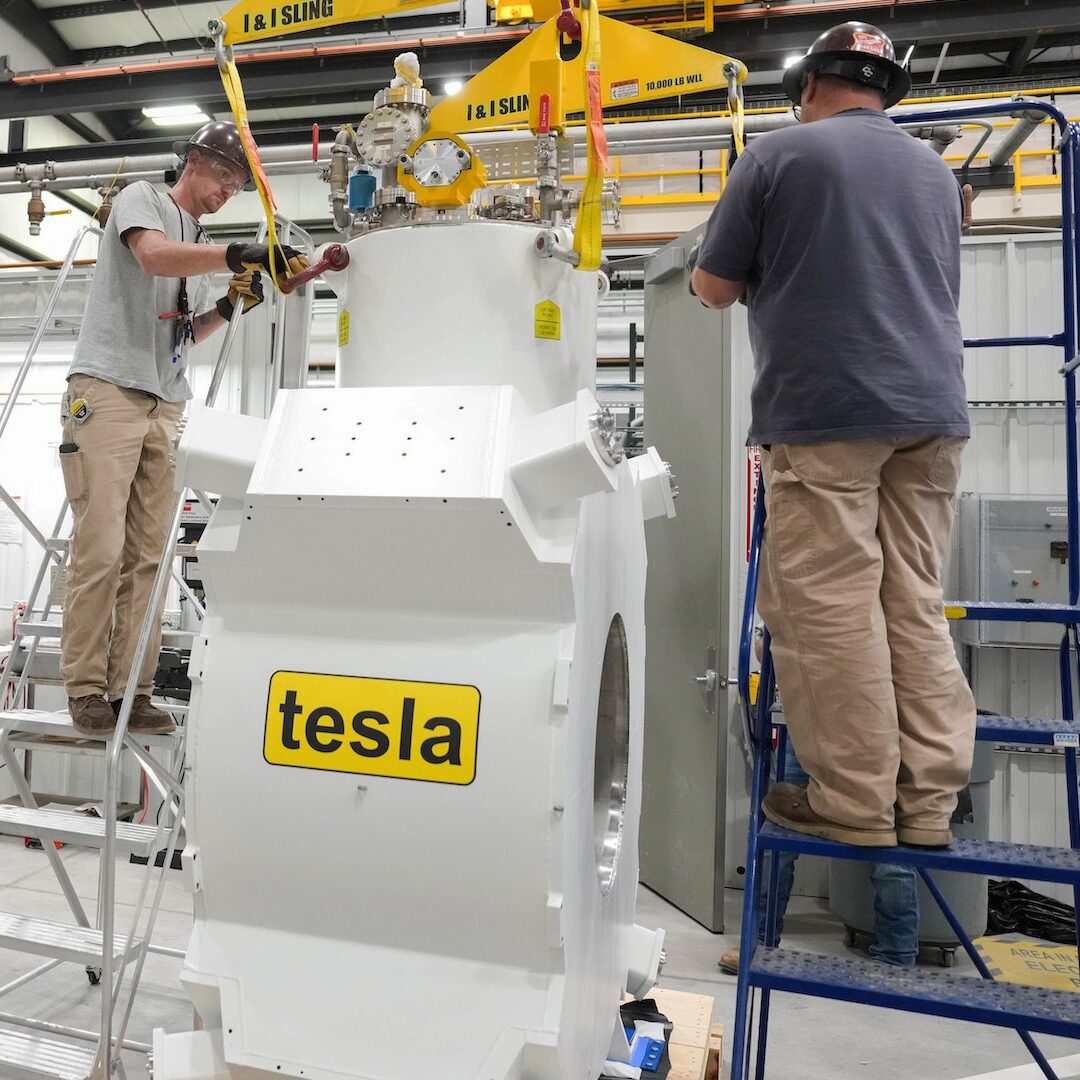
F&O Hoisting and Rigging team members work on placing MPEX’s large Upstream Helicon Magnet
The newly arrived downstream helicon (DSH) and electron cyclotron heating (ECH) superconducting magnets join the upstream helicon (USH) magnet, which was delivered to ORNL earlier this summer. The USH, DSH, and ECH magnets are similar in size and design, and are the three smallest of MPEX’s six superconducting magnet systems. The USH and DSH magnets are located on either side of the helicon source region, where the plasma is generated, while the ECH magnet is found farther down the device, in the region where powerful microwaves are injected into the plasma to heat the electrons.

The DSH and ECH magnets (foreground) in the MPEX high bay, with the USH magnet (background) undergoing site acceptance testing. Credit: Carlos Jones

The USH magnet being cooled to cryogenic temperatures with liquid helium as part of the site acceptance testing process. Credit: Carlos Jones
The USH magnet is currently undergoing site acceptance testing, a necessary step for all the magnets before installation on the device. Site acceptance testing involves cooling the magnets to cryogenic temperatures with liquid helium and deploying a suite of sensors to probe the magnetic field, confirming it is the required strength, shape, and uniformity.
The second half of the superconducting magnets are scheduled for delivery later this fall.
Helicon Source Region
The helicon source region, the “heart” of MPEX, was the first subsystem to be installed on the device. The helicon source is where MPEX’s linear plasma is generated, and consists of a launcher, limiter, diagnostics, and an enclosing magnet. The launcher uses radiofrequency energy to ionize deuterium gas and generate a high-density, low-temperature plasma, while the limiter defines the plasma’s outer boundary, helping to protect surrounding components. The water-cooled, copper-based magnet surrounding the assembly is the only non-superconducting system on MPEX, and guides the plasma both upstream, where it terminates in a dump tank, and downstream, where it is heated to temperatures closer to those inside a fusion device.

The internal launcher and limiter of the helicon source region before installation within the magnet. Credit: Amy Smotherman Burgess

The full helicon source region, with the launcher and limiter within the ringed magnet and the diagnostics module on the right. Credit: Carlos Jones
Diagnostics and Analytical Tools
This summer also saw the arrival and installation of two key tools for MPEX, the Diagnostic Residual Gas Analyzer (DRGA) and the Surface Analysis Station (SAS). The DRGA analyzes the exhaust stream from MPEX, measuring gas and impurity content to provide real-time information on the plasma during device operations. The tool was built to specification by Pfeiffer Vacuum Systems in Germany, and its instrumentation and design were based on a similar DRGA system ORNL is developing for the international ITER project.

The DRGA will be installed next to the MPEX device and provide near real-time insights on plasma behavior. Credit: Jonathan Perry
Once a material sample has been exposed to the plasma within MPEX, its first destination after removal from the machine is the Surface Analysis Station. The SAS is a scanning electron microscope-based suite of instrumentation that will be used to examine materials in-house without breaking vacuum. The SAS uses an electron beam to reveal the elemental composition and crystallographic orientation of a material and render high-resolution images of its surface to evaluate the degree of plasma damage. It also contains a plasma-focused ion beam capable of digging “trenches” in tungsten samples to examine the material below the surface. The SAS is housed in a room clad in special magnetic shielding alloy to protect the sensitive instrumentation, and was custom-built by Orsay Physics in France.

The SAS installed in its magnetically shielded room. Credit: Carlos Jones
Piece by piece, these deliveries and installations mark the transition from individual components toward an integrated scientific device and reflect the accelerating pace of progress at MPEX as it moves closer to first plasma and scientific operations. – Sean Simoneau